


How Should Shoes Fit If I Have Rheumatoid Arthritis?
Shoes should fit snug at the heel, roomy at the ball and toes, and adjustable as the day goes on. A thumb's width of space in front of the longest toe, no pressure over any joint, and a heel that stays seated are the three checks that matter most.
Rheumatoid arthritis makes fit harder than it is for most people, because foot volume moves — which is why shoes for rheumatoid arthritis are judged on adjustment, not on a single measurement. A pair that is correct at 8 a.m. can be tight by 4 p.m. The practical goal is not a perfect static fit but a fit you can adjust.
The Four Zones of Fit
Think of any pair of shoes for rheumatoid arthritis in four zones, each with its own requirement:
| Zone | Correct fit | What goes wrong |
|---|---|---|
| Heel | Snug, no vertical lift | Loose heel causes rubbing and blisters |
| Midfoot | Supported, not compressed | Over-tightening here is a common response to a loose heel |
| Ball of foot | Widest part of foot on widest part of shoe | Slight pressure here becomes pain within an hour |
| Toe box | 10–15 mm clearance, toes flat and untouching | Too short causes jamming; too tall allows clawing |
The order matters. Fix the heel first, then the midfoot, then check the toe clearance. Trying to solve a loose heel by pulling the laces tighter across the instep compresses the top of the foot, where rheumatoid nodules and tendon inflammation are common.
When to Try Shoes On
Fit your feet at their largest, not their smallest. For most people with rheumatoid arthritis that is late afternoon or early evening. Morning fitting overstates how much room you have.
Two further rules:
- Wear the socks you will actually wear. Thick socks can add half a width.
- Try both shoes, and walk for at least five minutes. Static fit in a shop hides what happens over a hundred steps.
What to Check Once the Shoes Are On
- Toes should wiggle freely and not touch the front or the sides.
- Run a thumb across the top of the toe box — you should feel the toe, not the shoe pressing it.
- Stand on tiptoe. The heel should stay down inside the shoe.
- Turn sharply. The foot should not roll inside the shoe.
- Remove the shoes and inspect for red marks: at the ball, the little toe joint, the top of the instep, and the heel.
- Red marks that fade within a minute are acceptable; marks that persist or indent the skin are not.
Adjusting Fit Through the Day
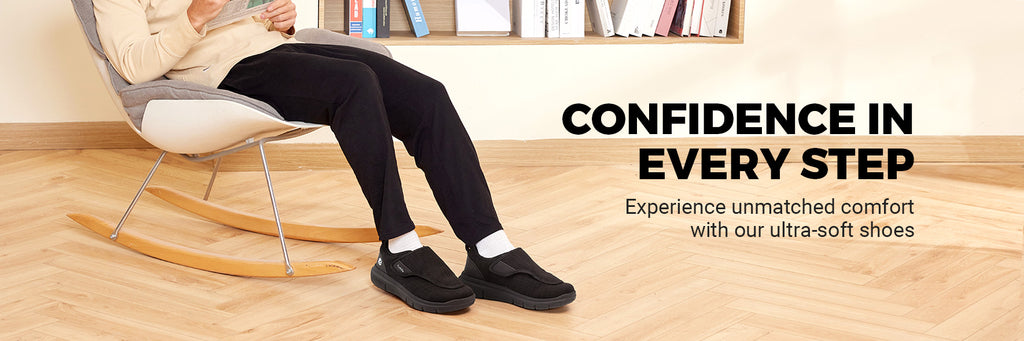
The practical response to changing volume is a closure you can re-tension without untying the whole shoe. Laces with elastic or a quick-pull system, Hook & Loop straps, and elastic gussets all allow a mid-day adjustment.
Depth matters too. If the top of your toes or the instep is pressed, a shoe with a removable insole or an explicitly deeper last gives you room without going wider than necessary.
Fitting Around Deformities
Hammer toes need a taller toe box. Bunions need width at the first metatarsophalangeal joint plus a soft upper that does not press the prominence. Toe drift needs a wide, squared or rounded toe box so the smaller toes are not pushed under. Claw toes need depth rather than length.
A shoe that is roomy in every direction is not the answer — excess length encourages the toes to claw for grip, and excess width lets the forefoot slide.
Men's Wide Fitting
The men's wide shoes collection carries widths up to 4E and 6E, with rounded toe boxes and adjustable closures across most models — the three features that make fitting around a changing foot practical rather than a compromise.
FAQ
How much room should there be at the toe?
Roughly 10 to 15 mm, about a thumb's width, in front of the longest toe when standing. More than that and the foot slides forward on descents.
Should shoes feel tight at first and stretch?
No. Upper materials give slightly, but they will not correct a shoe that presses a joint. Buy the fit you need on day one.
Is it normal for one shoe to feel different?
Yes. Asymmetric involvement is typical in rheumatoid arthritis. Fit the more affected foot and adjust the other shoe with an insole or a different lacing tension.
References
- Current extended-width options for men. Men's Wide Shoes
- Condition-grouped footwear. Men's Shoes for Arthritis
Related Questions
Further fit answers, all on this site:


