


Best Sports Shoe for Walking: How to Choose the Right Pair 2026

Walking is one of the simplest ways to stay active — but the wrong footwear can turn an enjoyable walk into an uncomfortable one. Whether you're walking around town, commuting to work, exercising, or heading out for a long weekend stroll, your shoes decide how your feet feel at the end of the day.
The best sports shoes for walking provide a combination of cushioning, support, and everyday comfort. They reduce fatigue, spread pressure more evenly across the foot, and let you keep moving without thinking about your feet.
With so many options on the shelf, how do you actually choose? This guide breaks down the features that matter, the buying checks that prevent expensive mistakes, and the shoe types that suit different walkers — including wide-fit picks for men and women.
What Makes a Good Sports Shoe for Walking?
Walking places repetitive, low-impact stress on your feet with every step. Compared with running, the forces are smaller — but you spend far longer on your feet, so small comfort problems compound over hours rather than minutes.
A good walking shoe balances six things:
- Cushioning
- Support
- Stability
- Flexibility
- Breathability
- A comfortable, roomy fit
Comfort isn't a vague marketing word here. A narrative synthesis of the footwear comfort literature published in the Journal of Foot and Ankle Research found that perceived comfort is shaped by measurable design features — midsole hardness, fit, and upper materials among them — and that comfortable footwear is associated with better function and lower injury risk (Menz et al., 2021).
Key Features to Look For
1. Cushioned Midsole
Cushioned midsoles help absorb impact and reduce foot fatigue during extended walks. Every step sends force through the heel, midfoot, and forefoot; a well-built midsole attenuates part of that load before it reaches your joints.
Look for:
- Shock-absorbing EVA or dual-density foam
- Responsive rebound rather than dead, mushy softness
- Adequate heel cushioning under the heel strike zone
- Durable midsole materials that hold their shape
One caveat worth knowing: cushioning is a consumable. Classic mechanical testing in the American Journal of Sports Medicine found that shoes retained roughly 75% of their initial shock absorption after 50 miles of simulated use, about 67% at 100–150 miles, and under 60% between 250 and 500 miles (Cook, Kester & Brunet, 1985). Shoes worn by real runners degraded more slowly, but the direction was the same. Your walking shoes will feel flatter long before they look worn out.
2. Arch Support and Stability
Supportive designs can promote a stable and comfortable stride on different walking surfaces. Support isn't about rigidity — it's about giving the foot a structured platform so the arch and heel aren't doing all the work.
Look for a firm heel counter, a contoured footbed, and a midfoot that resists twisting. A meta-analysis of 19 randomized trials in the British Journal of Sports Medicine found moderate-quality evidence that foot orthoses reduce plantar heel pain over 7–12 weeks, though the authors were careful to note the effect size may not be clinically dramatic (Whittaker et al., 2018). Translation: built-in arch support helps many people, but it's one input among several — not a cure.
3. Lightweight Construction
Lightweight construction makes sports shoes easier to wear for commuting, exercise, and daily walking. You lift each shoe thousands of times a day, and mass at the foot costs more energy than mass carried on the torso.
Research on runners measured roughly a 1% increase in oxygen uptake for every 100 g added per shoe (Franz, Wierzbinski & Kram, 2012). Walking is a lower-intensity activity, so the effect is smaller — but over a 10,000-step day, heavy shoes are noticeable.
Lightweight does not mean unsupportive. The goal is low weight with adequate structure, not low weight instead of it.
4. Breathable Upper
Breathable uppers help keep feet cool and dry during longer periods of activity. Heat and moisture buildup soften skin and raise friction, which is how blisters and hot spots start.
Engineered mesh and stretch knit uppers generally deliver:
- Better airflow
- Lower weight
- More give around the forefoot
- Less heat retention on warm days
5. Durable, Non-Slip Outsole
Flexible outsoles allow natural foot movement while providing reliable traction and stability. The shoe should bend where your foot bends — at the ball, not the arch — and grip reliably on wet pavement, tile, and gravel.
Traction is a genuine safety feature, not a spec-sheet flourish. A multicenter randomized controlled trial of 4,553 NHS staff in England found that issuing slip-resistant footwear cut workplace slips by roughly 37% compared with usual footwear (Bell et al., 2021). Reviews of footwear and falls in older adults reach a similar conclusion: low heels and firm, slip-resistant soles are among the most consistently supported recommendations (Menant et al., 2008; Cheever et al., 2026).
6. Wide Toe Box and Comfortable Fit
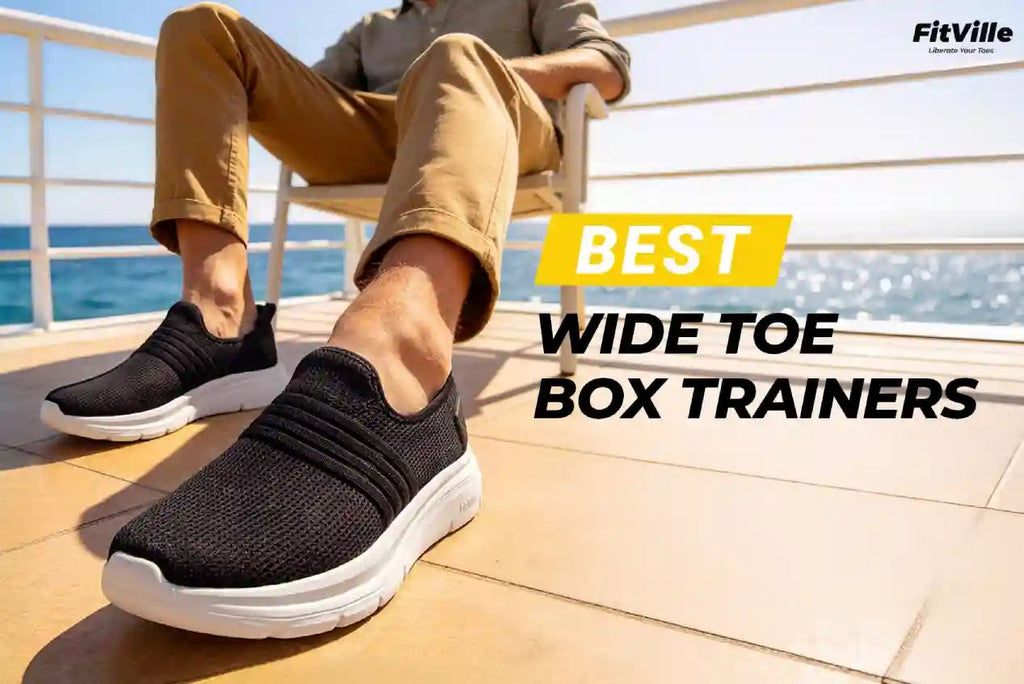
A comfortable fit with adequate toe room can help prevent pressure and discomfort during long walks. Many conventional sports shoes taper sharply at the forefoot, which squeezes the toes for anyone with naturally wide feet, bunions, or swelling.
Fit is the single most under-checked variable in footwear. A systematic search and narrative review found that a substantial share of adults — and a majority in several older and diabetic populations studied — wear shoes that don't match their measured foot dimensions, with incorrect fit associated with foot pain, corns, calluses, and structural deformity (Buldt & Menz, 2018).
The evidence on toe-box shape is more nuanced than marketing usually admits. A 2025 in-shoe pressure study of women with hallux valgus found that narrow footwear is a modifiable risk factor for developing the condition, but that simply widening the toe box of habitual footwear did not automatically reduce medial forefoot pressure in an established case (Bajraszewski et al., 2025). The practical reading: room in the forefoot is a sound preventive choice and usually more comfortable, but it isn't a treatment on its own.
Buying Tips
- Match cushioning to distance. Short errands need less stack than a 10 km weekend walk. If most of your walking is on concrete, favor more cushioning.
- Leave real toe room. Aim for roughly a thumb's width between your longest toe and the front of the shoe.
- Prioritize lightweight and supportive for long distances. One without the other gets uncomfortable past the first hour.
- Fix width with width, not length. If the shoe pinches at the sides, size up the width, not the length — a longer shoe just slides.
- Replace worn shoes on schedule. Cushioning degrades well before the outsole looks finished. Deep midsole creasing, a heel that no longer springs back under thumb pressure, or new aches after familiar walks are all signals.
- Try shoes later in the day. Feet swell over the course of a day; an afternoon fitting is closer to how the shoe will feel on a long walk.
Which Type of Walking Shoe Suits You?
| Type | Best For | Key Characteristics |
|---|---|---|
| Walking Shoes | Daily walking, commuting | Strong support, durable, built for hours on foot |
| Running Shoes | Brisk walking, fitness walking | Lightweight, high rebound, responsive cushioning |
| Wide Fit Walking Shoes | Wide or swollen feet | Roomy toe box, less forefoot compression |
| Orthopedic Walking Shoes | Sensitive feet, foot conditions | Structured arch support, pressure relief |
| Athletic Trainers | Mixed daily activity | Versatile, works across walking, gym, and errands |
Recommended: FitVille Men's Cloud Strider V3
If you want maximum cushioning without giving up forefoot room, the Men's Cloud Strider V3 is FitVille's thick-sole walking pick.
What it offers:
- 5 cm WidePlatform™ sole — a broad, thick base that spreads body weight and absorbs impact, well suited to long walks on hard surfaces
- Wide/2E and Extra Wide/4E widths with a roomy toe box and high instep
- ArchCore insole with a thickened arch lift and U-shaped heel cup for heel stability
- Stretch knit upper for airflow and give around the forefoot
- Slip-resistant EVA outsole for traction across changing surfaces
- ≈354 g per shoe (US 9) — light for the amount of stack height
- Zero break-in — comfortable from the first wear
Best for: walkers who want plush, high-stack cushioning, and anyone whose toes over-flex in a thin-soled shoe.

Recommended: FitVille Rebound Core V1
The Men's Rebound Core V1 is the classic all-day walking shoe in the range, and FitVille's most reviewed model.
What it offers:
- PropelCore™ sole system — dual-density EVA (firmer 58° heel, more flexible 53° forefoot), so the shoe supports where you land and bends where you push off
- EnergyWave™ pad and U-shaped memory foam insole for shock absorption at the heel
- TPU heel ring and firm heel counter to keep the rearfoot aligned over long distances
- Widths up to XX-Wide/6E — the widest option in the lineup
- Rigid rubber outsole for grip and motion stability
- ≈320 g per shoe (US 8)
- Built for around 8 hours of walking and standing
Best for: all-day wear, standing occupations, and anyone who needs genuine 6E width.

Best Women's Athletic Shoes for Walking
Women's feet are not simply smaller versions of men's — forefoot-to-heel width ratios and instep height differ, which is why the best women's athletic shoes for walking are built on a women's-specific last rather than scaled down from a men's mold.
The Women's Rebound Core V1 applies the same PropelCore™ midsole system on a women's fit, with the wide toe box, dual-density cushioning, and slip-resistant outsole intact. It's a practical everyday option for walking, commuting, and standing shifts.

When you're comparing women's athletic shoes for walking, check:
- Whether wide and extra-wide options are genuinely available, not just standard sizing
- Forefoot room across the ball of the foot, not just length
- Heel hold — a loose heel causes rubbing regardless of how good the cushioning is
- Instep volume, if the laces feel tight across the top of your foot
Browse the full range of women's athletic shoes and women's walking shoes.
How to Find the Right Fit
Even a technically excellent shoe is uncomfortable if it fits badly — and as the fit research above shows, mis-sizing is the norm rather than the exception.
- Measure both feet. They're rarely identical. Fit the larger one.
- Try shoes in the afternoon or evening, when your feet are at their largest.
- Check toe room. Your toes should move freely without touching the front.
- Check width separately from length. Side pressure means you need a wider fitting, not a longer shoe.
- Walk in them. Stand up, walk the length of the room, and pay attention to heel slip and forefoot pressure — not just how they feel standing still.
FitVille's width guide explains how 2E, 4E, and 6E map to actual foot measurements.
Common Foot Concerns
| Concern | What to Look For |
|---|---|
| Wide feet | A wider fitting (2E/4E/6E) — not a longer size |
| Bunions | A spacious toe box that avoids pressure on the big toe joint |
| Plantar heel pain | Cushioning plus a supportive footbed and firm heel counter |
| Swollen feet | Adjustable closures and wider fittings for changing foot volume |
| High instep | Generous upper volume and flexible upper materials |
If you have a diagnosed foot condition or persistent pain, footwear is a supporting measure — worth discussing with a podiatrist alongside your shoe choice.
Frequently Asked Questions
What is the best sports shoe for walking?
There's no single answer for everyone. The best sports shoe for walking combines a cushioned midsole, adequate arch support, lightweight construction, a breathable upper, a flexible non-slip outsole, and a fit with real toe room. Which balance suits you depends on your foot shape and how far you walk.
Can I use running shoes for walking?
Yes. Running shoes work well for brisk or fitness walking thanks to their light weight and responsive cushioning. Dedicated walking shoes usually offer more structure and durability for all-day wear.
How often should I replace walking shoes?
Cushioning degrades measurably with use, often well before the shoe looks worn. Replace when the midsole shows deep permanent creasing, no longer springs back under thumb pressure, or when familiar walks start producing new aches.
Do I need wide-fit shoes?
If your shoes feel tight across the ball of your foot, leave red marks, or you've been sizing up in length to gain room, a wider fitting is likely the better fix.
What are the best women's athletic shoes for walking?
Look for a women's-specific last, genuine wide-fit options, secure heel hold, and a cushioned but stable midsole. The Women's Rebound Core V1 covers all four.
Final Thoughts
A good walking shoe does more than feel soft in the store. It should combine comfort, support, stability, flexibility, breathability, and the right fit for your individual foot shape — and hold those properties over months of use.
Choosing the best sports shoe for walking depends on foot shape, cushioning, support, fit, and walking habits. For walkers who need extra room and all-day cushioning, the Men's Cloud Strider V3 and the Men's Rebound Core V1 offer two clear paths: maximum stack height, or maximum width and structure.
The right walking shoe keeps every step comfortable and supported.
Note: FitVille footwear is designed for comfort and support but is not intended for medical diagnosis or treatment. FitVille disclaims any responsibility for injuries or harm resulting from the use of this product.
References
- Buldt, A. K., & Menz, H. B. (2018). Incorrectly fitted footwear, foot pain and foot disorders: a systematic search and narrative review of the literature. Journal of Foot and Ankle Research, 11, 43. https://doi.org/10.1186/s13047-018-0284-z
- Menz, H. B., et al. (2021). Footwear comfort: a systematic search and narrative synthesis of the literature. Journal of Foot and Ankle Research, 14, 59. https://doi.org/10.1186/s13047-021-00500-9
- Cook, S. D., Kester, M. A., & Brunet, M. E. (1985). Shock absorption characteristics of running shoes. American Journal of Sports Medicine, 13(4), 248–253. https://journals.sagepub.com/doi/10.1177/036354658501300406
- Franz, J. R., Wierzbinski, C. M., & Kram, R. (2012). Metabolic cost of running barefoot versus shod: is lighter better? Medicine & Science in Sports & Exercise, 44(8), 1519–1525. https://pubmed.ncbi.nlm.nih.gov/22367745/
- Whittaker, G. A., et al. (2018). Foot orthoses for plantar heel pain: a systematic review and meta-analysis. British Journal of Sports Medicine, 52(5), 322–328. https://pubmed.ncbi.nlm.nih.gov/28935689/
- Menant, J. C., Steele, J. R., Menz, H. B., Munro, B. J., & Lord, S. R. (2008). Optimizing footwear for older people at risk of falls. Journal of Rehabilitation Research & Development, 45(8), 1167–1181. https://pubmed.ncbi.nlm.nih.gov/19235118/
- Bajraszewski, K. J., et al. (2025). Footwear toe-box shape and medial forefoot pressures in women with hallux valgus. Journal of Foot and Ankle Research, 18(2). https://doi.org/10.1002/jfa2.70041
- Bell, J. L., et al. (2021). Slip-resistant footwear reduces slips among National Health Service workers in England: a randomised controlled trial. Occupational and Environmental Medicine. https://www.ncbi.nlm.nih.gov/pmc/articles/PMC8223622/
- Cheever, K., et al. (2026). Evidence-based footwear recommendations for older adults: enhancing mobility, comfort, and fall prevention. Journal of the American Geriatrics Society. https://doi.org/10.1111/jgs.70111
About FitVille Footwear
Just Follow us on LinkedIn, Facebook, YouTube, Instagram, RSS feed and Pinterest to catch our brand news.



What FitViller Prefers
Best Shoes to Buy

Popular Men's Shoes
Popular Women's Shoes
