


Black Trainers for Women: How to Choose Comfortable Shoes 2026

Black trainers for women are a versatile footwear choice for everyday wear and fitness activities. They occupy a useful middle ground — tidy enough for the office, a client meeting or dinner out, and practical enough for the commute, a long day on your feet or a session at the gym. The classic black color pairs easily with casual outfits, activewear, and workwear. That versatility is why one well-chosen pair often does the job of two or three.
Styling, though, is only half the decision. Whether a pair still feels good at 7pm as well as 7am comes down to how it is built: cushioning, support, weight, breathability and — above all — fit. This guide covers what to look for, how the main styles differ, and what the research actually says about the features that make a difference.
Why Black Works So Well
Black remains the most reliable colour in the trainer aisle for a few practical reasons:
- It reads smart. A tonal, low-profile black trainer sits comfortably alongside tailored trousers or a midi skirt in a way that a bright running shoe does not.
- It hides wear. Scuffs, city grime and winter pavements show far less than they would on white leather or mesh.
- It works year-round. No seasonal colour to date it, and nothing to clash with the rest of your wardrobe.
- It suits more than one setting. The same pair can cover a commute, a weekend walk and a light workout.
What to Look For in Black Trainers for Women
1. Smart, Minimalist Styling
The details that make a trainer look smart rather than sporty are small but consistent: a slim, low-profile silhouette, a black sole rather than a contrasting white midsole, minimal branding, and a clean upper without busy panelling. Suede and leather read the smartest; knit and engineered mesh lean more athletic. If you want one pair to cross from desk to weekend, black-on-black is the safest choice.
2. Cushioned Midsole
Cushioned midsoles provide lasting comfort and help reduce foot fatigue throughout the day. This matters most if your day involves standing rather than sitting — a 2018 systematic review in Applied Ergonomics found a moderate level of evidence that cushioning materials reduce perceived musculoskeletal discomfort in the lower limb and lower back among workers who stand for long periods (Speed, Harris & Keegel, 2018).
In practical terms, look for a midsole that resists packing down: dual-density or resilient EVA foams hold their shape longer than a single soft layer, which can feel plush in the shop and flat within a few months. A removable insole is worth having too, so you can swap in your own orthotics if you use them.
3. Arch Support and a Stable Heel
Support is what keeps cushioning from turning into wobble. A contoured footbed, a firm heel counter and a midsole that does not twist easily all help hold the foot in a settled position through the day. This is a comfort and stability feature rather than a treatment for any condition, but for anyone walking or standing for hours it is often the difference between a shoe that feels fine and one that does not.
4. Breathable Upper
Breathable uppers promote airflow to keep feet cool and comfortable during extended wear. Dark uppers absorb more heat in direct sun, so ventilation matters more in a black trainer than the colour might suggest. Engineered mesh panels, a moisture-wicking lining and breathable materials around the forefoot all help — particularly if you tend towards warm feet or wear the same pair from morning until evening.
5. Lightweight Construction
Lightweight construction supports natural movement for walking, training, and daily activities. There is a measurable cost to carrying weight on your feet: research at the University of Colorado found that oxygen uptake rose by roughly 1% for every 100 g added per foot (Franz, Wierzbinski & Kram, 2012). Across a 10,000-step day, a shoe a few hundred grams lighter genuinely feels different. The aim is a light shoe that has not thrown away its cushioning to get there.
6. Durable, Non-Slip Outsole
Durable outsoles provide reliable traction and stability on a variety of indoor and outdoor surfaces. A rubber compound with a defined tread pattern grips better on wet pavements and polished indoor floors than a smooth, flat sole. A review of footwear features associated with stability identified a firm, slip-resistant sole, a low heel and a bevelled heel edge among the characteristics that support safer walking (Menant et al., 2008). Tread also wears down, so it is worth checking the sole of an older pair before assuming it still grips.
How to Choose the Right Pair
The best black trainers for women are the ones matched to how you actually spend your day rather than to how they look on a shelf. Five rules cover most of it:
- Go tonal for a smarter look. An all-black upper with a black sole and dark laces reads far dressier than the same shoe on a white midsole.
- Prioritise cushioning and support if you are on your feet. For desk-based days it matters less; for retail, hospitality, teaching or healthcare shifts it is the single most important factor.
- Choose width before length. A narrative review of footwear fitting found that between 63% and 72% of participants across the studies reviewed were wearing shoes that did not accommodate the length or width of their feet, and that poor fit was associated with foot pain and disorders including lesser toe deformity, corns and calluses (Buldt & Menz, 2018). If a trainer feels tight across the forefoot, look for a wider fitting rather than sizing up in length.
- Match the upper to the wardrobe. Leather or suede for workwear and smart-casual; knit or mesh if the pair is mostly for walking and training.
- Measure both feet, later in the day. Most people have one foot slightly larger, and feet expand after several hours of standing. Try trainers with the socks you would normally wear.

Which Style of Black Trainers Suits You?
Many black trainers for women combine modern styling with practical comfort and support features. The styles are not interchangeable, though, and this is roughly how they divide:
| Style | Best for | What stands out |
|---|---|---|
| Leather or suede trainers | Office and smart-casual wear | The most polished finish; wipes clean and holds its shape |
| Casual smart trainers | Daily commuting | The all-rounder — dresses up or down without looking out of place |
| Walking trainers | Long distances and all-day standing | The most cushioning and structured support of any style here |
| Wide-fit trainers | Wider feet, bunions or swelling | A roomier toe box that reduces rubbing across the forefoot |
| Slip-on trainers | Travel and quick changes | No laces to deal with, while still looking tidy |
Recommended: FitVille Women's Rebound Core V1
If you want the smart-black look with walking-shoe construction underneath, FitVille Women's Rebound Core V1 is the pair to start with. It covers the width problem most trainers ignore, and it is built for the long-standing, high-step-count days that flatten a cheaper midsole.
- Three fittings: Medium (D), Wide (2E) and Extra Wide (4E)
- Dual-density EVA midsole that resists packing down over time
- U-shaped arch support insole with a TPU heel ring for stability
- Slip-resistant rubber outsole for wet pavements and polished indoor floors
- Roughly 320 g in a US size 8 — light for a shoe with this much structure

Common Questions
Are black trainers for women appropriate for the office?
In most smart-casual workplaces, yes — provided the pair is minimal and tonal. An all-black leather or suede upper with a black sole and no contrast panelling passes as smart footwear in a way that a technical running shoe does not. Formal dress codes remain the exception.
What is the difference between wide and extra wide?
Width fittings describe the volume across the forefoot, not the length. Wide (2E) adds room over a standard fitting; Extra Wide (4E) adds more again, and is the usual choice for bunions, hammertoes or feet that swell through the day. Measuring the widest part of your foot against a brand's size chart is more reliable than guessing from your usual size.
How do I keep black trainers looking smart?
Wipe the uppers down regularly rather than waiting for marks to build up, use a suede brush on napped leather, and let a wet pair dry naturally away from direct heat. Rotating between two pairs also gives the midsole foam time to recover between wears.
Can the same pair work for the gym and for work?
For walking, cross-training and general gym use, yes. For running any real distance, or for court sports with quick lateral movement, a purpose-built shoe is the better choice — everyday trainers are not built for those loads.
Final Thoughts
Choosing the right black trainers for women depends on fit, cushioning, support, intended activity, and personal style. Get the width right first, then the cushioning and support your day actually demands, and let styling settle the remaining decision between two good options.
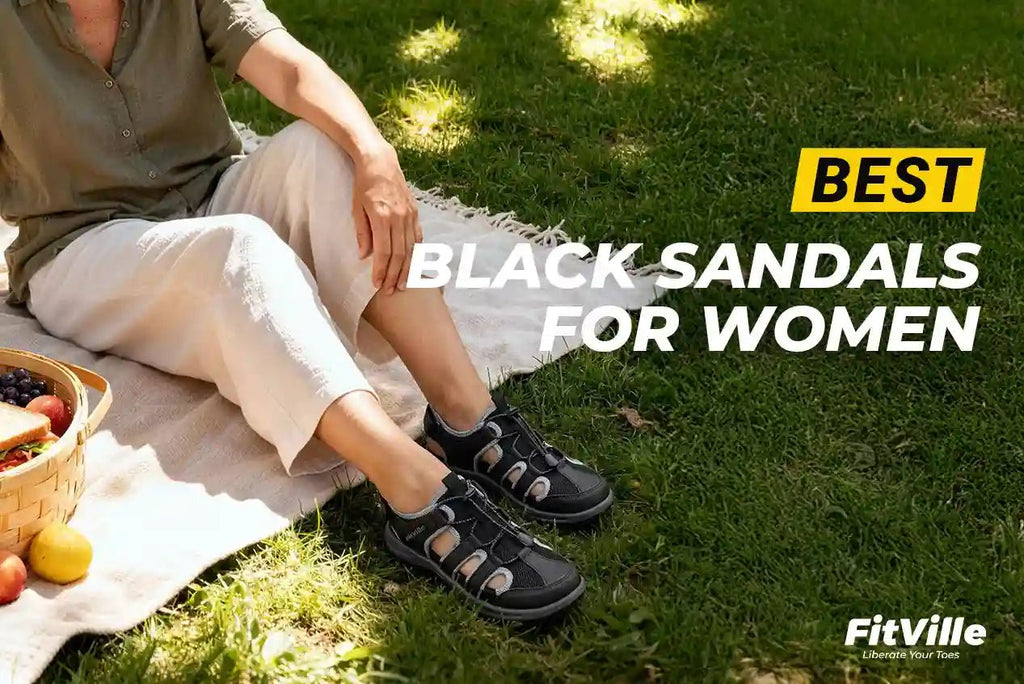
A sleek pair of black trainers offers effortless style and all-day comfort.
Note: FitVille footwear is designed for comfort and support but is not intended for medical diagnosis or treatment. FitVille disclaims any responsibility for injuries or harm resulting from the use of this product.
References
Buldt, A. K., & Menz, H. B. (2018). Incorrectly fitted footwear, foot pain and foot disorders: a systematic search and narrative review of the literature. Journal of Foot and Ankle Research, 11, 43.
Franz, J. R., Wierzbinski, C. M., & Kram, R. (2012). Metabolic cost of running barefoot versus shod: is lighter better? Medicine & Science in Sports & Exercise, 44(8), 1519–1525.
Menant, J. C., Steele, J. R., Menz, H. B., Munro, B. J., & Lord, S. R. (2008). Optimizing footwear for older people at risk of falls. Journal of Rehabilitation Research and Development, 45(8), 1167–1182.
Menz, H. B., Lord, S. R., & McIntosh, A. S. (2001). Slip resistance of casual footwear: implications for falls in older adults. Gerontology, 47(3), 145–149.
Speed, G., Harris, K., & Keegel, T. (2018). The effect of cushioning materials on musculoskeletal discomfort and fatigue during prolonged standing at work: a systematic review. Applied Ergonomics, 70, 300–314.
About FitVille Footwear
Just Follow us on LinkedIn, Facebook, YouTube, Instagram, RSS feed and Pinterest to catch our brand news.



What FitViller Prefers
Best Shoes to Buy

Popular Men's Shoes
Popular Women's Shoes
