


Fashionable Comfortable Sandals Buying Guide: How to Look Good in 2026

Finding sandals that are both fashionable and comfortable can feel like a compromise. Some pairs look great but leave your feet aching after a few hours. Others feel supportive but don't work with anything in your wardrobe.
You don't have to choose between the two.
Fashionable comfortable sandals combine modern design with all-day comfort, which makes them a practical choice for everyday wear, travel, holidays, shopping, and summer leisure. Today's designs pair supportive construction, cushioning, and adjustable fits with clean silhouettes, so you can stay comfortable from morning to evening without giving up your personal style.
The best fashionable comfortable sandals provide a combination of cushioning, support, and everyday comfort. This guide covers what actually makes a sandal comfortable, how to measure for the right fit, which style suits which occasion, and how to keep a pair wearable for more than one summer.
Why Comfortable Sandals No Longer Have to Look Boring
Comfortable footwear used to mean bulky shapes and purely functional designs. That has changed, largely because manufacturers stopped treating "supportive" and "attractive" as competing goals.
Modern comfortable sandals now offer:
- Sleek, versatile silhouettes
- Neutral colours that work across a wardrobe
- Adjustable straps in low-profile designs
- Contoured, anatomically shaped footbeds
- Lightweight, high-rebound midsoles
- Wide and extra-wide fitting options
The result is footwear you can wear all day and still feel good about wearing.
What to Look For in Fashionable Comfortable Sandals
1. A Roomy, Correctly Sized Fit
Fit is the foundation of comfort — and it is where most people get it wrong. A systematic review in the Journal of Foot and Ankle Research found that between 63% and 72% of people were wearing shoes that did not accommodate the length or width of their feet, and that poor fit is associated with foot pain and disorders such as lesser toe deformity, corns, and calluses.[^1] A separate cross-sectional study of older adults reached similar conclusions about how common ill-fitting footwear is in practice.[^8]
Look for:
- Wide (2E) or extra-wide (4E) fitting options, not just standard widths
- A spacious toe area that lets the toes splay naturally
- Enough depth across the instep, especially if you have a high arch
- Soft, flexible upper materials that don't cut across the foot
A comfortable fit with adequate toe room can help prevent pressure and discomfort during long walks. This matters most for naturally wider feet, bunions, hammertoes, or feet that swell.
How to measure your feet properly
- Measure in the late afternoon or evening, when your feet are at their largest.
- Stand on a sheet of paper with your full weight on the foot, and trace around it.
- Measure the longest point (usually heel to big toe, sometimes heel to second toe) in millimetres.
- Measure the widest point across the ball of the foot — this is the number most size charts ignore and most fitting problems come from.
- Measure both feet. Most people have one foot 3–5 mm larger; size to the bigger one.
- Compare against the brand's own chart, not your usual size. Sandal lasts vary far more than trainer lasts.
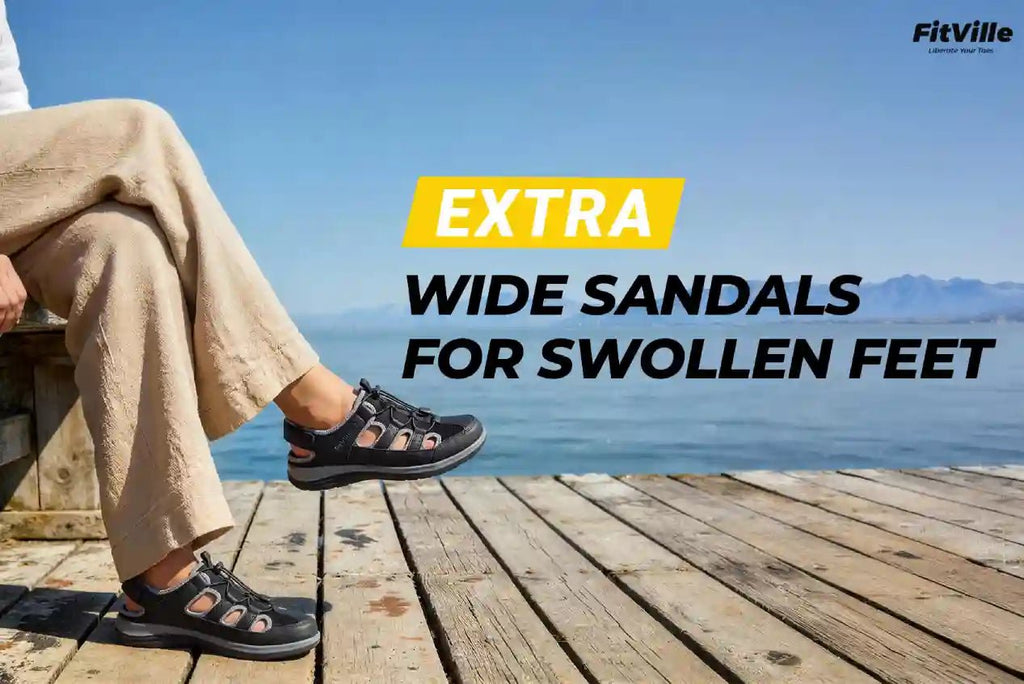
2. A Cushioned Footbed
A stylish sandal should still absorb impact. Cushioned footbeds help absorb impact and reduce foot fatigue during extended walks, which is exactly what you need for a full day of shopping, sightseeing, or travelling.
Research on footwear comfort points consistently in one direction: well-fitted, lightweight shoes with soft midsoles are the ones people rate as most comfortable.[^2] Biomechanical work comparing footwear types found that a properly constructed shoe produced a lower loading rate at initial contact than barefoot, flip-flops, or basic sandals — the cushioned midsole is doing measurable work.[^9]
Midsole materials worth knowing:
| Material | Feel | Trade-off |
|---|---|---|
| Standard EVA | Soft, light, affordable | Compresses over time; loses rebound fastest |
| Compression-moulded EVA | Firmer, more responsive, roughly 15% lighter than standard EVA | Costs more; slightly less plush on day one |
| Polyurethane (PU) | Dense and durable, holds shape longest | Noticeably heavier |
| Cork/latex footbeds | Moulds to the foot over time | Requires a break-in period; less forgiving initially |
If you plan to wear a pair for several hours at a stretch, cushioning stops being a luxury.
3. Arch Support
A completely flat sandal may look minimal and elegant, but it offers little structure for extended walking. A contoured footbed with genuine arch support helps distribute pressure across the whole plantar surface rather than concentrating it under the heel and the ball of the foot.
Supportive designs can promote a stable and comfortable stride on different walking surfaces. For people managing plantar heel pain, current best-practice guidance places footwear education in the core self-management package alongside stretching and taping, with foot orthoses added in a stepped approach if that isn't enough.[^3]
Good support can help:
- Reduce foot fatigue over long days
- Provide a more stable foundation on uneven ground
- Support natural foot alignment
- Spread pressure more evenly across the footbed
A quick in-store test: press your thumb into the arch area of the footbed. It should resist slightly and spring back, not collapse flat. Then hold the sandal at both ends and twist — a good walking sandal flexes at the forefoot but resists twisting through the middle.
4. Adjustable Straps
Feet are not the same size at 8am and 8pm. An MRI-based study of healthy volunteers found a highly significant increase in foot volume across a single day, with elevation of the foot measurably reducing it.[^4] Heat, long-haul travel, and standing all amplify the effect.
Adjustable straps let you loosen or tighten as the day goes on. That means you can:
- Fine-tune the fit in seconds without changing shoes
- Accommodate swelling in the afternoon and heat
- Relieve pressure points before they become blisters
- Keep the foot securely positioned rather than sliding forward
Comparing strap systems:
| System | Best for | Watch out for |
|---|---|---|
| Hook-and-loop (Velcro) | Swelling, arthritis, limited hand strength — adjust without bending down | Loses grip if the loop side fills with lint |
| Fast-pull lace system | Even pressure across the instep, sleek look | Less obvious to adjust one-handed mid-walk |
| Buckles | A precise, repeatable fit | Fixed increments; the right setting may sit between two holes |
| Elastic / slip-on | Convenience and quick errands | No real adjustment; the least secure option |
Secure fixation matters for more than comfort. Backless and loosely held styles give the foot less to work with, and wearers often compensate by gripping with the toes. Gait studies show flip-flops produce a shorter stride and altered ankle mechanics compared with closed footwear,[^5] a lower walking speed with higher shear force at the ankle joint compared with sports shoes,[^6] and increased tibialis anterior activation during swing.[^10] A sandal that stays put lets you walk normally.
5. Lightweight Construction
Nobody wants to feel extra weight on their feet. Lightweight construction makes sandals easier to wear for commuting, travel, and daily walking, and reduces fatigue over longer periods. Lightweight EVA midsoles and flexible synthetic uppers are the usual route — and lighter footwear scores better on comfort ratings in the research literature.[^2]
As a rough benchmark, a women's walking sandal in a UK 5 typically weighs 200–300 g per shoe. Much above that and you'll notice it by the end of a long day.
6. A Non-Slip Outsole
Style should never cost you stability. Your outsole is what keeps you upright on a wet promenade, a polished shop floor, or a marble step on holiday.
A review of footwear and fall risk concluded that firm, slip-resistant soles and low heels are the safer combination for everyday wear, both indoors and outdoors.[^7] Flexible outsoles allow natural foot movement while providing reliable traction and stability.
Look for rubber inserts or a treaded outsole rather than a smooth, flat sole. Keep any heel low and broad — a wide base gives more contact area and a more forgiving landing than a narrow one.

7. Breathability
Breathable, open uppers help keep feet cool and dry during longer periods of warm-weather activity. An open construction lets moisture evaporate rather than pooling in the footbed, which reduces the friction that causes blisters and the damp conditions that cause odour.
Look for perforated or knit uppers, moisture-wicking footbed linings, and smooth interior seams. If you wear socks with sandals, choose a thin moisture-wicking pair rather than cotton.
8. A Stylish, Versatile Design
Comfort features only help if you actually wear the sandals. Choose a clean silhouette in a neutral colour — black, brown, beige, taupe, or navy — and one pair will carry you across jeans, trousers, shorts, skirts, and summer dresses.
Buying Tips
- Match the style to the occasion. A slide for the pool is not the sandal for a six-hour walking day.
- Prioritise arch support and a cushioned footbed if you'll be on your feet for more than an hour or two at a time.
- Choose adjustable straps so the fit can change with your feet through the day.
- Check the outsole grip — press and flex it; it should have texture and give, not be a smooth flat plane.
- Shop later in the day, when your feet are at their largest.
- Measure width, not just length. Width is where most fitting errors happen.[^1]
- Try them on standing and walking, not sitting. Your foot spreads under load.
- Don't count on a break-in period. A well-constructed sandal should feel acceptable on day one; genuine pinch points rarely disappear.
Five common mistakes
- Buying by your usual number. Sizing varies widely between brands and between models within a brand.
- Ignoring width. A too-narrow sandal in the correct length will still cause pressure and rubbing.
- Assuming flat means comfortable. A flat sandal offers no structure; a low, contoured footbed usually feels better over distance.
- Choosing a strap you can't easily adjust. If it's fiddly, you won't adjust it, and the fit will be wrong for half the day.
- Wearing last summer's pair for a walking holiday. A compressed footbed and a worn outsole are exactly the wrong combination on unfamiliar surfaces.
Which Sandal Type Suits Which Occasion?
| Type | Best for | Characteristics | Typical support level |
|---|---|---|---|
| Casual sandals | Everyday wear, errands, short walks | Versatile and easy to style; comfortable enough for regular use | Medium |
| Walking sandals | Travel, sightseeing, long days out | Strongest cushioning and support; secure multi-point straps; grippy outsole | High |
| Platform sandals | Fashion-forward outfits | Added height with a cushioned base; look for a stable, wide platform and low heel-to-toe drop | Medium |
| Slide sandals | Poolside, quick on/off, short trips | Simple and convenient; nothing holding the heel, so best for short distances | Low |
| Dress sandals | Events and smarter occasions | Elegant lines; choose a low, broad heel over a narrow one | Low to medium |
| Recovery sandals | After exercise, standing shifts, evenings at home | Thick, soft footbed with a deep heel cup; prioritises cushioning over structure | Medium (cushioning-led) |
Choosing the best comfortable sandal depends on foot shape, cushioning, support, fit, and wearing habits. Most people are best served by two pairs: one supportive walking sandal, and one dressier pair for occasions.

Recommended: FitVille Women's FlexiWalk Sandal V3
If you want sandals that combine everyday style with foot-friendly construction, the FitVille Women's FlexiWalk Sandal V3 is built for exactly the use case this guide describes: daily urban wear, outdoor leisure, light activity, and all-day standing or walking.
Key features:
- Wide toe box — available in Wide (2E) and Extra Wide (4E), with room across the forefoot for wider feet, bunions, and swelling
- ArchCore™ insole — breathable and moisture-wicking, with targeted arch support and impact absorption
- High-rebound EVA midsole — absorbs shock and returns energy, reducing fatigue over long hours of standing or walking
- Fast-pull lace system + adjustable heel strap — quick on/off and a secure, personalised fit for different foot shapes
- EVA outsole with rubber inserts — traction and stability on everyday surfaces
- Neutral colourways — Black, Warm Taupe, and Grey/Taupe pair easily with summer outfits

Also worth considering from the same range:
| Model | What's different | Best for |
|---|---|---|
| FlexiWalk Sandal V6 | Three hook-and-loop straps at instep, ankle, and heel | Significant swelling, or if you want to adjust without bending down |
| FlexiWalk Sandal V7 | Knit upper with fast-pull laces and adjustable heel strap | Extra give across the forefoot; works with an AFO or orthotic |
| FlexiWalk Sandal V1 | Adjustable hook-and-loop straps, wide toe box, high-rebound midsole | High insteps and a simpler, classic strap layout |
Comfortable Sandals for Wide Feet
Women with wider feet often find fashionable sandals the hardest category to shop. A design can look attractive and still pinch across the toes or the sides of the foot — and width, not length, is where sizing most often fails.[^1]
If you have wide feet, look for:
- Wide or extra-wide width options (2E, 4E), sold as genuine widths rather than a size up
- A spacious forefoot with a footbed that extends fully under the ball of the foot
- Adjustable straps that open wide enough to get the foot in without forcing
- Flexible uppers with no hard overlays across the widest part of the foot
- A cushioned footbed deep enough to seat the foot rather than perch it
Why sizing up isn't the same as going wider: a larger size adds length as well as width, which moves the arch support behind where your arch actually sits and lets the heel slip. A true wide fitting keeps the length correct and adds volume where you need it.
Foot Comfort Needs to Consider
| Concern | What helps |
|---|---|
| Bunions | A wider toe area reduces pressure around the big toe joint; avoid straps that cross directly over the bunion |
| Swollen feet | Adjustable straps accommodate changes in foot volume through the day[^4] |
| Sensitive feet | Soft materials and smooth interiors reduce rubbing and irritation |
| Plantar heel pain | Cushioning plus appropriate arch support improves everyday walking comfort[^3] |
| Arthritis | A roomy fit and an easy closure reduce pressure around sensitive joints and make the sandal easier to put on |
| Hammertoes | Adequate toe-box depth, not just width, so the upper doesn't press on the raised joints |
| Balance concerns | A firm, slip-resistant outsole and a secure heel strap rather than a backless style[^7] |
If you have a diagnosed foot condition, treat this as general guidance and speak with a podiatrist about what suits your feet specifically.
How to Style Comfortable Sandals
- Casual: jeans or relaxed trousers with a lightweight top
- Summer: a flowing dress or midi skirt
- Travel: linen trousers or shorts, with one neutral pair covering the whole trip
- Smarter occasions: a tailored short and a structured top, with a dress sandal in a low block heel
Choosing a neutral colour is the single easiest way to make one comfortable pair work across an entire wardrobe. If you're packing for a trip, a supportive sandal in black or taupe plus one pair of trainers usually covers everything short of a formal event.
Caring for Your Sandals
- Wipe the footbed after hot days. Sweat and dust build up into an abrasive layer that causes rubbing.
- Wash straps by hand in cool water with mild soap; avoid the washing machine, which can distort mouldings and degrade adhesives.
- Air-dry away from direct heat. Radiators and hot windowsills shrink and harden EVA.
- Clean hook-and-loop closures with a stiff brush to remove lint — most "failed Velcro" is just a clogged loop side.
- Alternate pairs where you can. Midsole foam recovers between wears, so two pairs alternated last considerably longer than one worn daily.
When to replace: if the footbed shows a permanent impression of your foot, the arch has flattened, the outsole tread is smooth in the heel or forefoot, or straps no longer hold tension, the sandal has stopped doing its job — regardless of how it looks from above.
Frequently Asked Questions
Can sandals really be supportive?
Yes — provided they have a contoured footbed, a cushioned midsole, and straps that hold the foot in place. A flat, backless sandal offers little of this; a structured walking sandal offers most of it.
Are flip-flops bad for your feet?
They change how you walk. Studies have measured a shorter stride and altered ankle mechanics in flip-flops compared with closed shoes,[^5] lower walking speed with greater shear force at the ankle compared with sports shoes,[^6] and higher tibialis anterior activation during the swing phase.[^10] They're fine for short distances; they aren't walking footwear.
How do I know if a sandal is too narrow?
If the strap edges leave marks, or your toes press against or overhang the sides of the footbed, the width is wrong. Width mismatch is more common than length mismatch.[^1]
Should I size up if my feet swell?
Adjust rather than oversize. A sandal with adjustable straps lets you loosen the fit in the evening without the shoe sliding around in the morning.[^4]
What should I look for in a sandal for a walking holiday?
Cushioning, arch support, secure multi-point straps, a grippy outsole, and a lightweight build — in that order. Wear them for several full days at home before you travel.
Can I wear sandals with orthotics?
Some models allow it — look for a removable footbed and enough depth. Adjustable straps help, because an orthotic raises the foot and takes up volume.
How long should a pair of sandals last?
Worn most days through a summer, expect one to two seasons before the footbed compresses. Alternating between two pairs roughly doubles that.
Are platform sandals a bad idea for comfort?
Not inherently. A wide, stable platform with a low heel-to-toe drop can be perfectly comfortable. The problem is height combined with a narrow base and no strap holding the heel.
Final Thoughts
The best fashionable comfortable sandals don't ask you to choose between looking good and feeling good.
Prioritise a correctly sized, roomy fit, a cushioned and supportive footbed, adjustable straps, a lightweight build, and a grippy outsole — then pick the design you actually want to wear. Whether you're heading out for a summer day, travelling, shopping, or taking a casual walk, the right pair keeps your feet comfortable from morning to evening.
Look stylish while enjoying all-day comfort with the right pair of sandals.
Note: FitVille footwear is designed for comfort and support but is not intended for medical diagnosis or treatment. FitVille disclaims any responsibility for injuries or harm resulting from the use of this product.
References
[^1]: Buldt AK, Menz HB. Incorrectly fitted footwear, foot pain and foot disorders: a systematic search and narrative review of the literature. Journal of Foot and Ankle Research. 2018;11:43. https://doi.org/10.1186/s13047-018-0284-z
[^2]: Menz HB, Bonanno DR. Footwear comfort: a systematic search and narrative synthesis of the literature. Journal of Foot and Ankle Research. 2021. https://doi.org/10.1186/s13047-021-00500-9
[^3]: Morrissey D, Cotchett M, Said J'Bari A, Prior T, Griffiths IB, Rathleff MS, Gulle H, Vicenzino B, Barton CJ. Management of plantar heel pain: a best practice guide informed by a systematic review, expert clinical reasoning and patient values. British Journal of Sports Medicine. 2021;55(19):1106–1118. https://doi.org/10.1136/bjsports-2019-101970
[^4]: Freund W, Wikstroem P, Wunderlich AP, Schuetz U, Beer M. Sitting foot: posture dependent changes of volume, edema and perfusion of the foot. A prospective interventional study with 27 volunteers. BMC Musculoskeletal Disorders. 2024;25. https://doi.org/10.1186/s12891-024-07971-4
[^5]: Shroyer JF, Weimar WH. Comparative analysis of human gait while wearing thong-style flip-flops versus sneakers. Journal of the American Podiatric Medical Association. 2010;100(4):251–257. https://pubmed.ncbi.nlm.nih.gov/20660875/
[^6]: Chen TL-W, Wong DW-C, Xu Z, Tan Q, Wang Y, Luximon A, Zhang M. Lower limb muscle co-contraction and joint loading of flip-flops walking in male wearers. PLOS ONE. 2018;13(3):e0193653. https://doi.org/10.1371/journal.pone.0193653
[^7]: Menant JC, Steele JR, Menz HB, Munro BJ, Lord SR. Optimizing footwear for older people at risk of falls. Journal of Rehabilitation Research and Development. 2008;45(8):1167–1181. https://pubmed.ncbi.nlm.nih.gov/19235118/
[^8]: O'Rourke B, Walsh ME, Brophy R, Vallely S, Murphy N, Conroy B, Cunningham C, Horgan NF. Does the shoe really fit? Characterising ill-fitting footwear among community-dwelling older adults attending geriatric services: an observational cross-sectional study. BMC Geriatrics. 2020;20:55. https://doi.org/10.1186/s12877-020-1448-9
[^9]: Zhang X, Paquette MR, Zhang S. A comparison of gait biomechanics of flip-flops, sandals, barefoot and shoes. Journal of Foot and Ankle Research. 2013;6:45. https://doi.org/10.1186/1757-1146-6-45
[^10]: Price C, Andrejevas V, Findlow AH, Graham-Smith P, Jones R. Does flip-flop style footwear modify ankle biomechanics and foot loading patterns? Journal of Foot and Ankle Research. 2014;7:40. https://doi.org/10.1186/s13047-014-0040-y
About FitVille Footwear
Just Follow us on LinkedIn, Facebook, YouTube, Instagram, RSS feed and Pinterest to catch our brand news.



What FitViller Prefers
Best Shoes to Buy

Popular Men's Shoes
Popular Women's Shoes
