


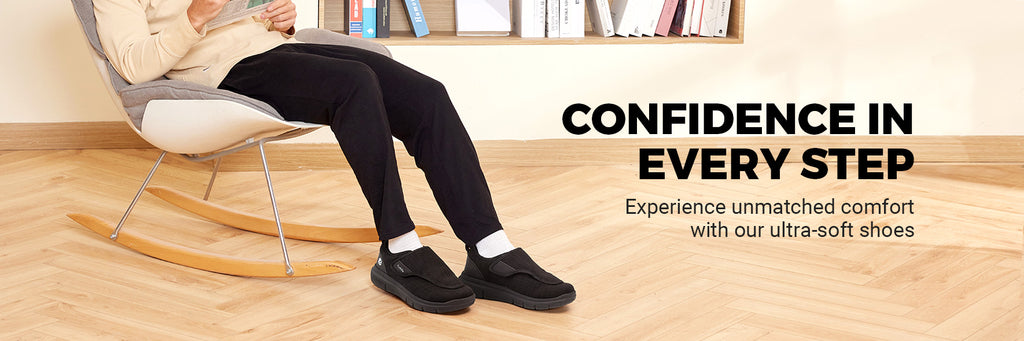
What to Look for in Shoes for Rheumatoid Arthritis?
When you shortlist shoes for rheumatoid arthritis, look for real width options up to 4E or 6E, a rounded toe box, a soft seam-free upper, an adjustable closure and a cushioned, stable sole.
That list is short on purpose. Most footwear that disappoints people with rheumatoid arthritis fails on two or three of those points, and the features that get the most marketing attention are rarely the ones that decide comfort.
The Shortlist: Eight Things Worth Checking
| Feature | What to check | Why it matters |
|---|---|---|
| Width range | Sizes in 2E, 4E or wider | An actually wide shoe, not just a wide-sounding name |
| Toe box shape | Rounded, no sharp taper | Toes stay straight instead of crowding |
| Upper material | Soft knit, mesh or nubuck | Moves with the foot and softens contact over joints |
| Seam placement | Nothing hard over a joint or bunion | Removes the most common cause of rubbing |
| Closure | Laces, Hook & Loop or straps; easy to reach | Lets you re-fit the shoe as swelling changes |
| Midsole | Cushioned but not compressible | Absorbs impact without letting the foot drift |
| Sole flexibility | Bends under the ball of the foot | Keeps the foot rolling through a step |
| Entry | Wide opening, pull tab, elastic gusset | Usable when hands or bending are affected |
Fit Rules That Matter More Than Features
Measure and try on at the end of the day, when your feet are fullest. Fit the larger foot and never assume both feet match. Stand during the assessment, because feet spread under load. Keep about a thumb's width in front of your longest toe, and confirm that the widest part of your foot sits over the widest part of the shoe. Walk on a hard floor as well as carpet — instability shows up fastest on tile.
If you use prescription or off-the-shelf insoles, bring them. An insole changes the internal volume of the shoe, and a wide fit plus a thick insole can end up as tight as the narrow shoe you started with.
What to Avoid
- Rigid leather uppers with stiff panels over the forefoot.
- Slip-on styles with no adjustment, unless the fit is generous and secure.
- Very soft, unsupportive soles that let the foot sink and the arch collapse.
- Sizing up to gain width — it usually moves the flex point rather than solving the problem.
- Shoes with a narrow, pointed toe box, however good they look.
- Belts and straps that cross directly over a tender joint.
Do You Need a Podiatrist or Orthotist?
If your foot shape has changed significantly, or if you need custom insoles, a podiatrist or orthotist can measure you properly and advise on shoe modifications. Rheumatology teams often have a foot specialist attached. Their input is most useful when you bring the shoes you intend to buy with you, rather than a general description.
A useful rule: shoes first, insoles second. An insole cannot widen a shoe that is too narrow.
Wide Shoes for Men
Men's wide shoes collection is the direct page for comparing current wide and extra-wide styles for men, with widths up to 4E and a rounded toe box across most models. If you prefer to browse by condition rather than by width, see Men's Shoes for Arthritis.
Check the width options, upper materials, and return terms on each current product page before you order.
FAQ
How much space should there be in front of my toes?
About one thumb's width, roughly 1 cm or half an inch, measured while standing in your usual socks with the shoe fastened as you would wear it.
Are memory foam shoes a good choice?
They can feel pleasant at first, but foam that compresses fully gives up its support. Look for cushioning that stays resilient under your body weight rather than flattening within a month.
Should I buy two different sizes?
If your feet differ by more than half a size in length or one width grade, yes — buying for the larger foot and adjusting the other side is the practical solution. Never accept a tight shoe on the assumption that it will stretch.
References
- Current men's extended-width footwear options. Men's Wide Shoes
- Condition-grouped men's footwear. Men's Shoes for Arthritis


